

 Socious Report
 Socious Work
 Socious Verify
HKEX Proposed Scope 3 Work Plan, Then Removed It
When a regulator consults on a relief, most of the attention goes to what it proposed. The more useful signal is sometimes what it decided not to keep.
Hong Kong Exchanges and Clearing consulted on a scope 3 interim provision. Where an issuer had not yet managed to disclose all of its scope 3 greenhouse gas emissions, it would publish two things instead: information, to the extent reasonably available, that would let investors understand its relevant upstream or downstream activities along the value chain, and its work plan, progress and timetable for making the required disclosure.
That is the most accommodating transitional measure a disclosure regime can offer. It converts a missing number into a described intention.
78% of respondents supported it.
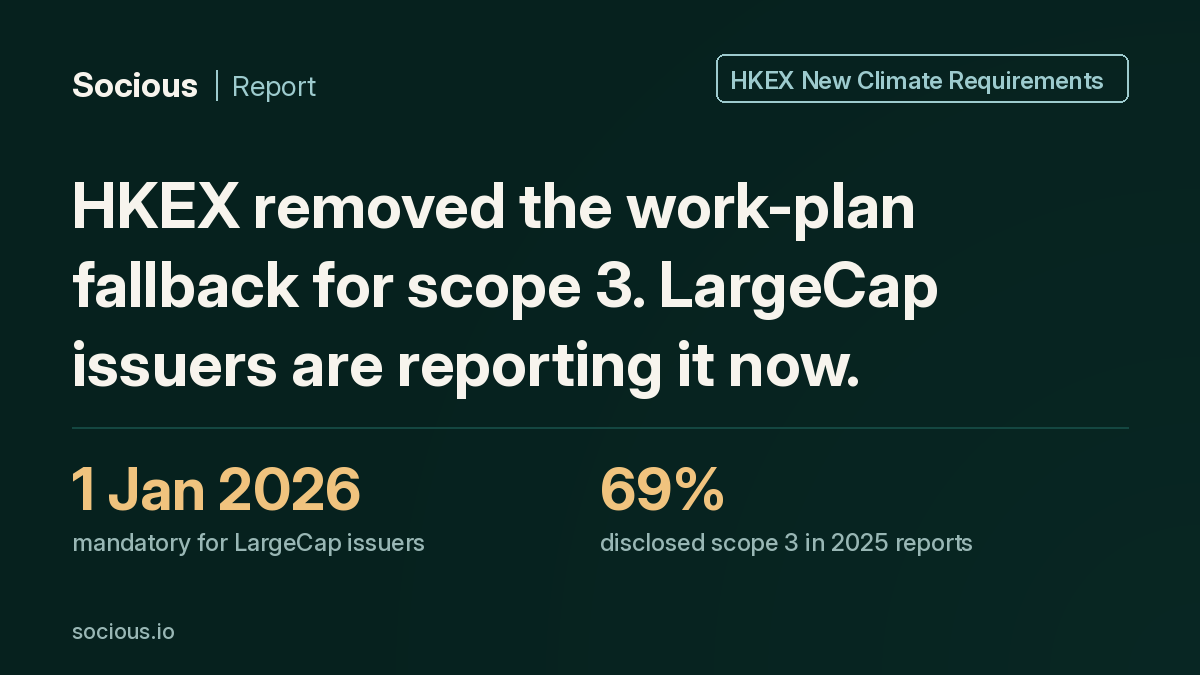
HKEX removed it from the final Rules.
The reasoning, and why it narrows things
The Exchange’s stated reasoning was that two other features already addressed the concern: the phased approach to implementation, and the Reasonable Information Relief.
Both are real. Neither does what the interim provision would have done.
The phased approach is about timing. Disclosure of scope 1 and scope 2 emissions became mandatory for all issuers for financial years commencing on or after 1 January 2025. Main Board issuers other than LargeCap Issuers report the remaining climate requirements on a comply or explain basis from the same date. GEM issuers are encouraged to report them voluntarily. LargeCap Issuers, meaning Hang Seng Composite LargeCap Index constituents, report on a mandatory basis for financial years commencing on or after 1 January 2026.
So the phasing buys time. It does not change what has to be in the report when the time arrives.
The Reasonable Information Relief is about measurement. HKEX defines it as a proportionality relief under the ISSB Climate Standard which enables issuers to use all reasonable and supportable information available to them at the reporting date without undue cost or effort to make certain disclosures. Alongside it, the Exchange confirmed that an issuer may use information from a reporting period different from its own under specific circumstances, and that it should disclose which categories of scope 3 activities are included, in accordance with the Greenhouse Gas Protocol Corporate Value Chain (Scope 3) Accounting and Reporting Standard (2011).
Read that carefully. It governs the quality of inputs you are allowed to rely on. It is a rule about how you measure.
The interim provision would have been a rule about whether you report at all in a given year. That one is gone.
An issuer in scope and short of data is therefore expected to produce a measured figure using reasonable and supportable information, not a paragraph explaining when a figure will exist.
Who is caught, and when it was decided
The scope test has a feature that rewards reading the paragraph rather than the headline.
HKEX wrote that issuers which are Hang Seng Composite LargeCap Index constituents throughout the year immediately prior to the reporting year will need to make mandatory disclosures from 2026 onwards. Accordingly, issuers that are constituents of the HSCLI throughout their entire financial year 2025 will be required to make mandatory climate disclosure in respect of their ESG reports for the financial year 2026, and those ESG reports will be published in 2027.
Two consequences follow.
The first is that eligibility for the 2026 obligation was settled by index membership during 2025. That year is closed. No action taken now changes whether an issuer is in scope for its current financial year.
The second is stickiness. The Exchange added that once an issuer becomes subject to mandatory disclosure of the New Climate Requirements, it must continue to disclose in accordance with them even if it subsequently ceases to be an HSCLI constituent. Leaving the index does not release an issuer from the regime it has entered.
For an issuer on a calendar financial year, the first mandatory year began on 1 January 2026 and is nearly over. The scope 3 figure for that year is being determined by data that either was collected during it or was not.
What the readiness numbers say
HKEX publishes an annual review of issuers’ reports, and the December 2025 edition assessed LargeCap readiness directly, covering 98 LargeCap Issuers excluding secondary listings.
Scope 1 and scope 2 disclosure is effectively universal at the top of the market: 100% of LargeCap Issuers, unchanged from the prior year, against 97% of all issuers.
Scope 3 is a different picture. 69% of LargeCap Issuers disclosed scope 3 emissions, up from 50% the year before. Across all issuers the figure was 41%.
Which means roughly a third of the cohort that moves to mandatory reporting for financial years commencing on or after 1 January 2026 had not published a scope 3 number at the time of the review.
Depth varies too. Among LargeCap Issuers that did report scope 3, 92% disclosed a breakdown of scope 3 categories, and 75% disclosed specific emission data by category. By sector, scope 3 disclosure ran at 71% in telecommunications, 53% in financials and 48% in conglomerates.
A category breakdown without per-category data is a map without distances. It is also, for many issuers, the honest current state of their value chain reporting.
Assurance is the next thing, and it is not here yet
It is worth stating plainly what Hong Kong has not done, because the two get conflated.
Independent assurance is not mandatory under the Rules at this stage. The practice is nonetheless common at the top of the market: 70% of LargeCap Issuers obtained independent assurance, against 9% of all issuers. Among that 70%, 96% disclosed the level, scope and processes adopted, and 83% obtained assurance specifically on scope 1 and scope 2 emissions.
Note where that assurance is being pointed. Scope 1 and 2, overwhelmingly.
The Exchange has said it plans to consult the market in 2027 on, among other things, mandating sustainability assurance for all or part of the sustainability disclosures and how such a requirement would be phased in.
So the sequence for a Hong Kong issuer is readable. Scope 1 and 2 mandatory, done. Climate requirements mandatory for LargeCap, running now. Scope 3 inside that, with a measurement relief but no work-plan substitute. Assurance, consulted on in 2027.
Anyone building a reporting process on the assumption that scope 3 will stay unassured should notice that the assurance conversation starts the year after the first mandatory scope 3 reports are filed.
What this means for a value chain
The practical burden of scope 3 does not fall on the issuer alone. It falls on everyone who sells into the issuer.
An issuer applying the Reasonable Information Relief still has to produce a number, and the quality of that number is a function of what its suppliers can hand over. Suppliers who can produce clean, dated, category-mapped emissions data make their customer’s disclosure defensible. Suppliers who cannot become the reason a figure is weak.
This is the same dynamic already running through scope 3 reporting under CSRD, and it is why the same supplier dataset tends to get asked for by several customers in several jurisdictions at once. Hong Kong is now one more of them. Our ISSB adoption tracker sets out where the others stand.
The regimes differ. The data underneath them mostly does not.
Where to start
If you are inside the Hong Kong regime, the question for the next few weeks is narrow: for the financial year now ending, can you produce a scope 3 figure, by category, from information you can show was reasonable and supportable at the reporting date?
If the answer is no, the work-plan route that was consulted on is not available to you.
Socious Report takes one dataset and drafts audit-ready reports against CSRD, SSBJ and ISSB from it, with an independent Socious Verify credential on the result. The point is that the collection happens once.
Start with a free readiness check: socious.io/ssbj-check