

 Socious Report
 Socious Work
 Socious Verify
New Zealand Gave Scope 3 Assurance Two More Years. It Left Scope 1 and 2 Assurance Exactly Where It Was.
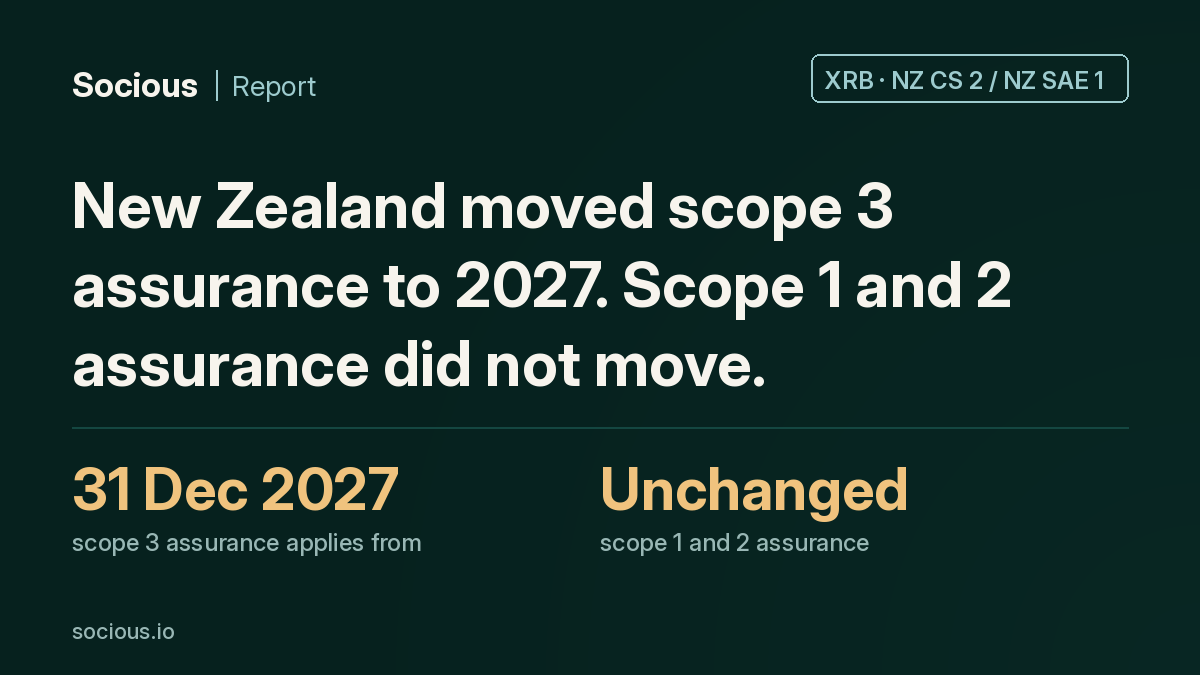
Most reporting relief arrives as one date moving. New Zealand’s 2025 amendments moved one date and deliberately pinned another, and the standard says so in a paragraph that exists only to stop people misreading it.
Two amending standards were made in November 2025. Both are secondary legislation under the Financial Reporting Act 2013. They apply to entities required by Part 7A of the Financial Markets Conduct Act 2013 to prepare climate statements.
What moved
The XRB’s amending standard to NZ CS 2 extends three adoption provisions by two years: anticipated financial impacts, scope 3 GHG emissions, and scope 3 GHG emissions assurance. The related comparatives and trend-analysis provisions move with the scope 3 one.
The assurance change is the cleanest to read, because the amending standard prints the old text struck through and the new text underlined. NZ SAE 1 paragraph 7A now reads that a Climate Reporting Entity may use adoption provision 8 to exclude scope 3 disclosures from the scope of the assurance engagement “in relation to accounting periods ending before 31 December 2027”, and that assurance of scope 3 “will apply in relation to accounting periods ending on or after 31 December 2027”. The figure 2025 is struck out in both sentences.
Paragraph 8.1 of NZ CS 2 carries the same edit: adoption provision 8 is available in relation to accounting periods ending before 31 December 2027.
The amending assurance standard commences for accounting periods beginning on or after 1 January 2025. It was published on 13 November 2025 and took effect on 11 December 2025.
What did not move, and the paragraph that says so
Paragraph 7B of NZ SAE 1 is the one to read twice:
For the avoidance of doubt, if adoption provision 8 of NZ CS 2 is used, the scope 1 and scope 2 GHG emissions disclosures shall be the subject of an assurance engagement in accordance with NZ SAE 1.
A paragraph beginning “for the avoidance of doubt” is a drafter telling you where readers go wrong. The doubt here is obvious enough. An entity that reads “scope 3 assurance deferred to 2027” and concludes its GHG assurance obligation is deferred to 2027 has misread the standard by two full scopes.
Scope 1 and 2 assurance is live now, on the same engagement it was always going to be on. The relief subtracts scope 3 from the scope of that engagement. It does not postpone the engagement.
Two reliefs, two different clocks
Both changes arrived in the same document, which is how the difference between them gets missed in planning.
The scope 3 disclosure exemption, adoption provision 4, is counted in the entity’s own reporting periods. Paragraph 17 now exempts scope 3 disclosure in an entity’s “first reporting period, second reporting period, third reporting period and fourth reporting period”. Before the amendment it ran to the second. The comparatives provisions in paragraphs 19 and 19.1 extend the same way, in reporting-period steps, out to a fifth and sixth reporting period depending on how many earlier periods the entity used the exemption for.
The scope 3 assurance exemption, adoption provision 8, is counted on the calendar. Accounting periods ending before 31 December 2027, full stop. It does not care whether this is the entity’s third reporting period or its fifth.
Two entities with identical obligations and different first reporting periods therefore share one scope 3 assurance deadline while holding different scope 3 disclosure deadlines, so a late entrant to the regime receives more disclosure relief on the same assurance date as everyone else.
There is a practical consequence for anyone whose fourth reporting period ends after 31 December 2027. The disclosure exemption and the assurance exemption stop protecting you on different dates, and the assurance one stops first for most balance dates.
One thing the XRB did not extend
The consultation proposed four extensions. The XRB approved three. The transition-planning extension was not approved, and the stated reason was user demand for that disclosure.
Preparer capacity therefore carried the two data-heavy items and did not carry transition planning, which is the narrative disclosure users told the board they read.
The comparatives follow the exemption, entity by entity
There is a third layer under the disclosure relief, and it is the one that decides how much work a late starter actually avoids.
If an entity uses the scope 3 exemption, it also gets relief from the comparative-information requirement in NZ CS 3 paragraph 40, which otherwise asks for two preceding reporting periods for every metric disclosed. The amended paragraph 19.1 sets out four cases, and they key on how many early periods the entity took the exemption for.
Take the exemption for the first period only, and the entity may exclude scope 3 comparatives in its second period and give one year of comparatives in its third. Take it for the first and second, and those two reliefs shift to the third and fourth periods. Take it for the first three, and they shift to the fourth and fifth. Take it for all four, and the entity may exclude scope 3 comparatives in its fifth reporting period and give one year of comparatives in its sixth.
Paragraph 22.1 does the same thing for the analysis-of-trends requirement in NZ CS 3 paragraph 42, excluding scope 3 from the trend analysis across the periods the exemption was used plus one.
So the disclosure relief compounds. An entity that used every available exemption from the start is not producing a full scope 3 series until its sixth reporting period, while its assurance date arrived on 31 December 2027 regardless. The amending standard to NZ CS 2 carries a mandatory date of 1 January 2025, meaning reporting entities must apply it for accounting periods beginning on or after that date, so none of this is optional sequencing.
Why this matters outside New Zealand
The sequence here is the one most jurisdictions are heading toward. Scope 1 and 2 assured first. Scope 3 disclosed before it is assured. Scope 3 assurance last, and moved more than once.
Singapore deferred its scope 1 and 2 assurance to FY2029 while keeping scope 3 disclosure mandatory for Straits Times Index constituents from FY2026. India let listed companies choose between third-party assessment and assurance for its BRSR Core. The common thread is that the assurance leg is where regulators have given ground and the disclosure leg is where they have held.
If you report in more than one of these places, the planning unit is not the jurisdiction. It is the scope, and the question for each scope is which clock that jurisdiction counts it on.
Where to start
If you are a New Zealand Climate Reporting Entity, confirm the two dates separately. Your scope 3 disclosure obligation is set by your reporting period number. Your scope 3 assurance obligation is set by 31 December 2027. Write both in the same place.
If you have been treating the November 2025 amendments as general relief, check paragraph 7B against what your assurance practitioner has scoped for this year. Scope 1 and 2 are in that engagement.
If you report in New Zealand and anywhere else, the two-clock problem repeats. A dataset that satisfies disclosure does not automatically satisfy assurance, and the gap between those two is the evidence trail, not the numbers.
Socious Report builds audit-ready CSRD, SSBJ and ISSB-aligned reports from one dataset, and attaches an independent Socious Verify credential to the result. Collect once.
Start with the free readiness check: socious.io/issb