

 Socious Report
 Socious Work
 Socious Verify
California SB 253: What Is Actually Due on 10 November 2026
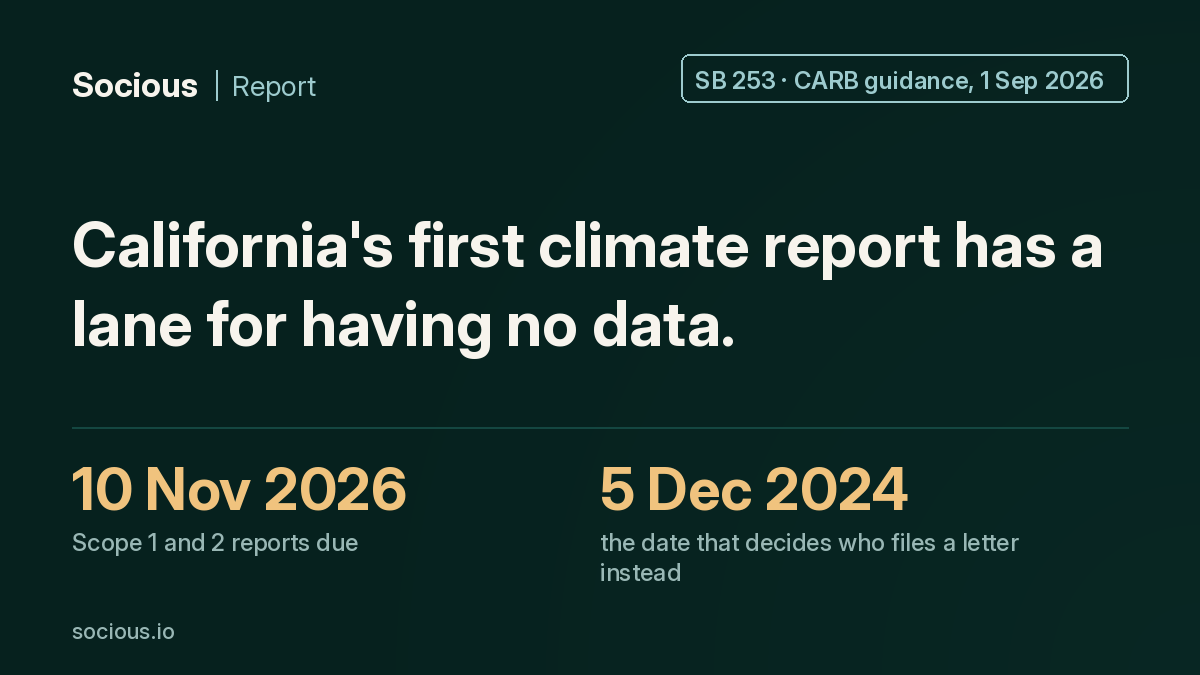
California’s first mandatory corporate climate reports are due on 10 November 2026.
For a large number of covered companies, the thing they file will not be an emissions figure. It will be a letter saying they do not have one.
That is not a loophole anyone found. It is in the California Air Resources Board’s own guidance, and whether it applies to you was decided on 5 December 2024.
The deadline, and where it comes from
SB 253, the Climate Corporate Data Accountability Act, sits in the California Health and Safety Code at section 38532. It requires large companies doing business in California to report greenhouse gas emissions.
The date comes from CARB’s regulation rather than the statute. CARB’s guidance for 2026 reporting submittals, issued on 1 September 2026, states it directly:
The Initial Regulation would require reporting entities to report their Scope 1 and Scope 2 emissions for the applicable preceding fiscal year, as determined under section 96076 of the Initial Regulation, on or before November 10, 2026.
The Initial Regulation is codified at Title 17 of the California Code of Regulations, Article 6, sections 96070 to 96077. CARB’s board approved it in February 2026 with a first-year deadline of 10 August 2026, and the date later moved out by three months.
Two things are worth separating. Scope 3 is not required this cycle. Only scope 1 and scope 2, for the applicable preceding fiscal year.
The 5 December 2024 test
CARB issued an enforcement notice on 5 December 2024. That date now functions as a dividing line between two completely different filing obligations, and it is retrospective: nothing a company does today changes which side of it they were on.
CARB’s guidance puts it this way:
Entities that were not collecting data or were not planning to collect data, at the time the December 2024 Enforcement Notice was issued, are not expected to submit Scope 1 and 2 reporting data for this first reporting cycle.
For a company in that position, CARB asks for something else:
CARB requests that such entities submit a statement of non-reporting (on company letterhead) indicating that they were not collecting data and were not planning to collect data at the time the Enforcement Notice was issued.
CARB notes that several companies have already sent one. The statement goes through CARB’s intake platform or to its climate disclosure inbox, before 10 November 2026.
So the first question a covered company answers is not what its emissions were. It is what it was doing almost two years ago.
What a company that does have data files
For everyone else, CARB’s first-year enforcement discretion is wide, and the guidance lists the acceptable formats:
- An existing annual report that includes scope 1 and 2 emissions.
- Existing scope 1 and 2 data already reported to other programmes or voluntary initiatives.
- CARB’s draft scope 1 and 2 template, posted on 10 October 2025. Using the template is voluntary for this cycle.
The permission underneath that list matters more than the list. CARB will accept scope 1 and 2 emissions “based on information they already have or were collecting when the December 2024 Notice was issued”. A company is not expected to have built a new inventory for this deadline. It is expected to hand over the one it had.
CARB also encourages, without requiring, the context that makes a number readable: methodologies, data sources, global warming potential values, emission factors, organisational boundaries, disaggregated data by category and gas, and assumptions.
Assurance: required by statute, not enforced this cycle
This is the line most likely to be misread, so here it is as CARB wrote it:
HSC section 38532 requires limited assurance beginning in 2026. As described in the FAQ document, given first-year enforcement discretion, CARB will accept submissions whether or not assurance has been obtained for the 2026 cycle.
The statutory requirement exists. The enforcement of it, for this cycle, does not. Those are different facts and a reporting team should keep them apart, because only one of them is temporary.
A practical note on scope 2 emission factors
CARB does not mandate an emission factor dataset for 2026. It addresses a live problem instead: the US Environmental Protection Agency has not released eGRID 2024 on its usual timeline.
CARB’s answer is that reporting entities may use the most recent official EPA release, eGRID 2023, or the eGRID 2024 dataset published by the Cornerstone Sustainability Data Initiative, generated from the EPA’s own publicly available source code. Alternative credible sources are allowed, and CARB asks companies to identify which factors they used.
If your scope 2 number moves between years for no operational reason, this is why, and saying so in the submission is cheaper than explaining it later.
SB 261 is a separate law on a separate track
SB 261, covering climate-related financial risk reports, applies at a lower revenue threshold than SB 253. CARB’s own description of the pair is that the regulation “covers large corporations doing business in the state with revenue over $500 million or $1 billion depending on the statute”.
Its status today is different. In CARB’s words: “Pursuant to a court order, CARB is not enforcing SB 261, and reporting is voluntary.” CARB has said it will not enforce the statutory 1 January 2026 deadline for posting and submitting those reports.
Companies have filed anyway. By February 2026, more than 120 climate-related financial risk reports had been voluntarily submitted and made public through CARB’s docket, from manufacturing, technology, healthcare, energy, transportation, finance and consumer services.
What happens after this cycle
CARB is explicit that this year is not the template:
CARB is currently undertaking a second rulemaking process in which it is developing the reporting requirements for 2027 and subsequent years, including GHG accounting methodologies, deadlines, assurance requirements, and reporting formats.
Its guidance closes by saying it applies only to the first reporting cycle.
So the relief available in 2026 is bounded on every side. The non-reporting letter covers this cycle. The assurance discretion covers this cycle. Scope 3 is absent from this cycle. The accounting methodologies that will govern the next one are being written now.
A company filing a letter this November is not finished. It has one reporting cycle, roughly a year, to build an inventory before the rules that replace this year’s discretion arrive.
What this means if you report in more than one jurisdiction
Most companies large enough for SB 253 are already inside at least one other regime. The EU’s CSRD, Japan’s SSBJ standards, and ISSB adoption across Asia and beyond all ask for scope 1 and 2, with different boundaries, different assurance timing and different formats.
The practical lesson of this California cycle is about the shape of the work rather than California itself. The companies that could file emissions in November are the ones that were already collecting in 2024, for some other reason, under some other framework. The data foundation preceded the obligation, which is the pattern every one of these regimes rewards.
Building that foundation once, in a form each regime can draw from, is the difference between a filing season and a scramble. It is also the difference between a company that can answer a customer’s scope 3 questionnaire next year and one that cannot.
Socious Report turns one dataset into AI-drafted CSRD, SSBJ and ISSB reports, with an independent Socious Verify credential on the result. If you want to see where your data stands before the 2027 rules land, start with our free readiness check at socious.io/csrd-check, or read how we approach ISSB-aligned reporting.