

 Socious Report
 Socious Work
 Socious Verify
The ISSB's Four Amendments to IFRS S2: What Changes in 2027
On 11 December 2025 the ISSB issued Amendments to Greenhouse Gas Emissions Disclosures—Amendments to IFRS S2, together with its Basis for Conclusions. They apply to reporting periods beginning on or after 1 January 2027. Early application is permitted (IFRS Foundation, 11 December 2025).
The ISSB states the purpose in one line: to provide a timely response to specific application challenges identified during implementation of IFRS S2 (Targeted amendments to IFRS S2—At a glance, PDF).
There are four, and here is what each one does.
1. Scope 3 Category 15 can be limited to financed emissions
An entity is permitted to limit measurement and disclosure of Scope 3 Category 15 greenhouse gas emissions to financed emissions as defined in IFRS S2.
For a bank or an asset manager, Category 15 is the largest and least tractable part of the inventory. The boundary is now the definition IFRS S2 itself carries.
The work this changes is scoping, not measurement technique. Exposure types inside the IFRS S2 definition need a measurement method, a data pipeline and a control. The rest of Category 15 is no longer a disclosure obligation under this standard.
2. Financed emissions can be disaggregated outside GICS
Alternative classification systems, beyond the Global Industry Classification Standard, may now be used to disaggregate information about financed emissions.
A financial institution already classifies its book by regulatory sector code, by internal industry taxonomy, and by whatever its supervisor requires in prudential returns. Requiring GICS for this one disclosure meant building a second mapping, maintaining it, reconciling it to the first and explaining the differences.
The institution can now disaggregate on a classification it already runs. The amendment does not name a replacement for GICS, so the choice of system, and the disclosure of which was used, sits with the preparer.
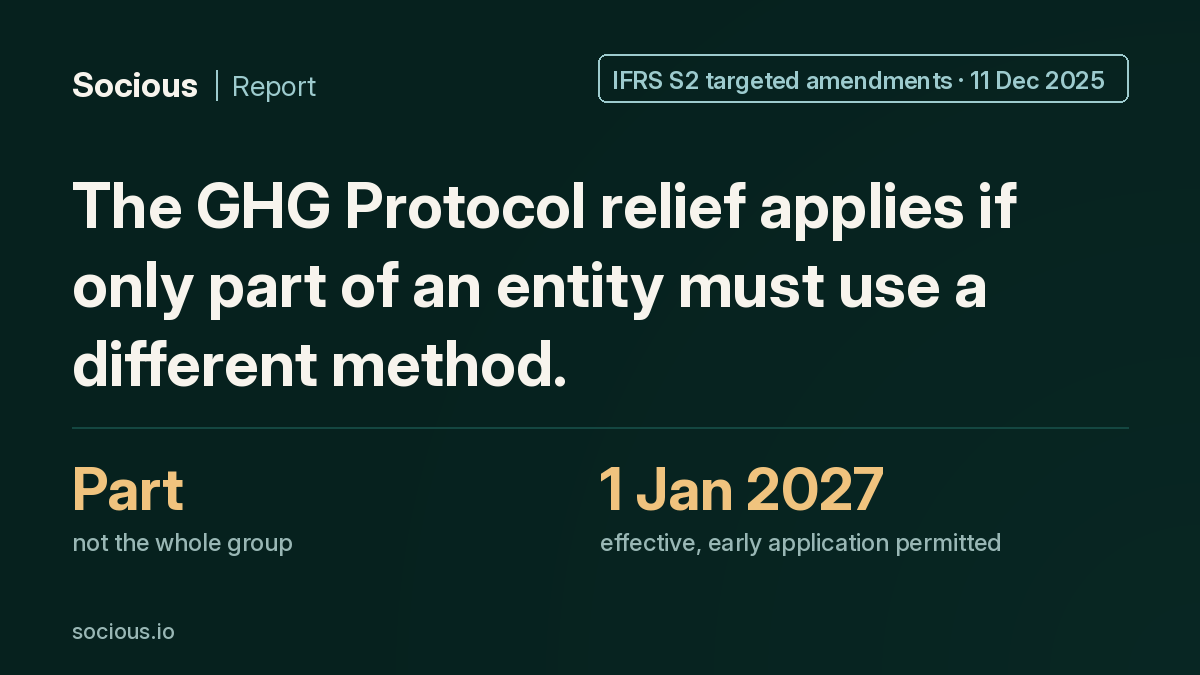
3. The GHG Protocol relief applies to part of an entity
The jurisdictional relief from using the GHG Protocol Standard is available if only part of an entity is required to use a different method for measuring greenhouse gas emissions.
A multinational is on the GHG Protocol nearly everywhere and on something else in one or two countries, where a regulator mandates a national method. Read as an entity-level switch, the relief would have been unusable for the companies it was written for.
One consolidated climate disclosure can therefore carry more than one measurement basis. The preparer owes a record: which part of the group measured on which basis, under which requirement, and for which period.
The local finance or EHS team that made the choice usually holds that detail. Getting it into the group file is easier during the period than after it.
4. A jurisdictional relief on global warming potential values
There is a new jurisdictional relief from using global warming potential values from the latest IPCC Assessment Report for converting greenhouse gas emissions.
GWP values convert a tonne of methane or nitrous oxide into a tonne of CO2 equivalent. The IPCC revises them between Assessment Reports. A jurisdiction that wrote a specific Assessment Report into its rules keeps that requirement until it amends it, so preparers there were converting the same physical emissions twice, on two sets of factors, for two filings.
The relief lets the jurisdiction’s required values stand. Two companies can now report the same physical emissions as different CO2e totals, and both are compliant. The report has to say which basis produced the total.
What triggers a jurisdictional relief
Two of the four are described by the ISSB as jurisdictional reliefs. The third carries its condition in the text: it applies if only part of an entity is required to use a different method.
A group cannot adopt a national measurement method in one country because it finds that method cheaper, more familiar or more flattering, and then claim the relief. The relief exists where a jurisdiction has imposed something the standard would otherwise conflict with. The GWP relief works the same way, addressing the case where a jurisdiction requires conversion factors other than the latest IPCC ones.
So the file needs more than the method a subsidiary used. It needs the requirement that made the method necessary, and the period that requirement covered. An assurer looking at a consolidated disclosure with two bases in it will ask for that evidence.
Who each amendment lands on
The first two are for financial institutions. A bank, an insurer or an asset manager reporting financed emissions is affected by both, and by the SASB alignment below. A manufacturer with no investment book is affected by neither.
The third and fourth are for groups with operations in a jurisdiction that mandates its own measurement method or its own conversion factors. Whether they apply is a question about where a group operates, not about its sector or its size. A mid-sized group with one subsidiary in such a jurisdiction is inside the third amendment. A large group entirely on the GHG Protocol is outside it.
A group can be in all four at once, and the four are independent. Claiming the Category 15 boundary says nothing about whether the GHG Protocol relief applies, and taking one early does not commit a preparer to taking the others.
What has not changed
IFRS S2 still requires disclosure of Scope 1, Scope 2 and Scope 3 greenhouse gas emissions. The GHG Protocol remains the measurement basis, which is why the relief from it is written as a relief. The effective date of IFRS S2 itself is untouched; 1 January 2027 is the date these amendments start to apply, not the date the standard does. Assurance is also unaffected, because IFRS S2 does not set an assurance requirement. Each jurisdiction decides the level and the timing of assurance over these numbers, and nothing in the December 2025 package moves those dates.
The consequential change
The ISSB aligned the financed emissions metrics in three SASB Standards with the amended requirements in IFRS S2. An institution using both does not have to hold the two in tension on this point.
The amendments were published with their Basis for Conclusions. The ISSB also noted that educational material on the amendments was under development.
What this asks of a reporting team in 2026
Write down, for each entity in the group, which method it measures on, in which jurisdiction, and under which requirement. The third amendment only helps a company that can show where that boundary falls. The same map answers the GWP question, because the two tend to arise in the same places.
Then decide on early application. It is permitted, so a group that benefits from the Category 15 boundary or the GHG Protocol clarification can take these changes before 2027. Early application moves the comparative period, which brings in the prior-year numbers and the people who own them.
Saying which basis was used where is not boilerplate. An analyst, an assurer or an acquirer needs it to read the total.
Socious Report files one dataset into CSRD, SSBJ and ISSB formats, with an independent Socious Verify credential on top. Our free CSRD readiness check shows where your current emissions data would fail a controls-based review. Background on the standards is in what the ISSB, IFRS S1 and IFRS S2 actually require.