

 Socious Report
 Socious Work
 Socious Verify
Mexico's NIS: 30 Sustainability Indicators, in the Notes to the Financial Statements
Almost every sustainability disclosure regime of the last five years has put the information in its own document. CSRD gives it a dedicated sustainability statement inside the management report. IFRS S1 and S2 produce a general purpose sustainability-related financial disclosure. SSBJ lands in the Japanese securities report alongside, but distinct from, the financial statements.
Mexico went the other way. Its sustainability indicators go in the notes to the financial statements.
That single structural choice changes who produces the numbers, what they have to reconcile to, and who reads them.
What the standards are
Mexico’s financial reporting standard-setter, CINIF, published two Sustainability Information Standards (Normas de Información de Sostenibilidad, NIS) on 13 May 2024 (Greenberg Traurig).
NIS A-1, the Conceptual Framework of Sustainability Information Standards, sets the basis, including the definitions of relevance and materiality (Jones Day, September 2026).
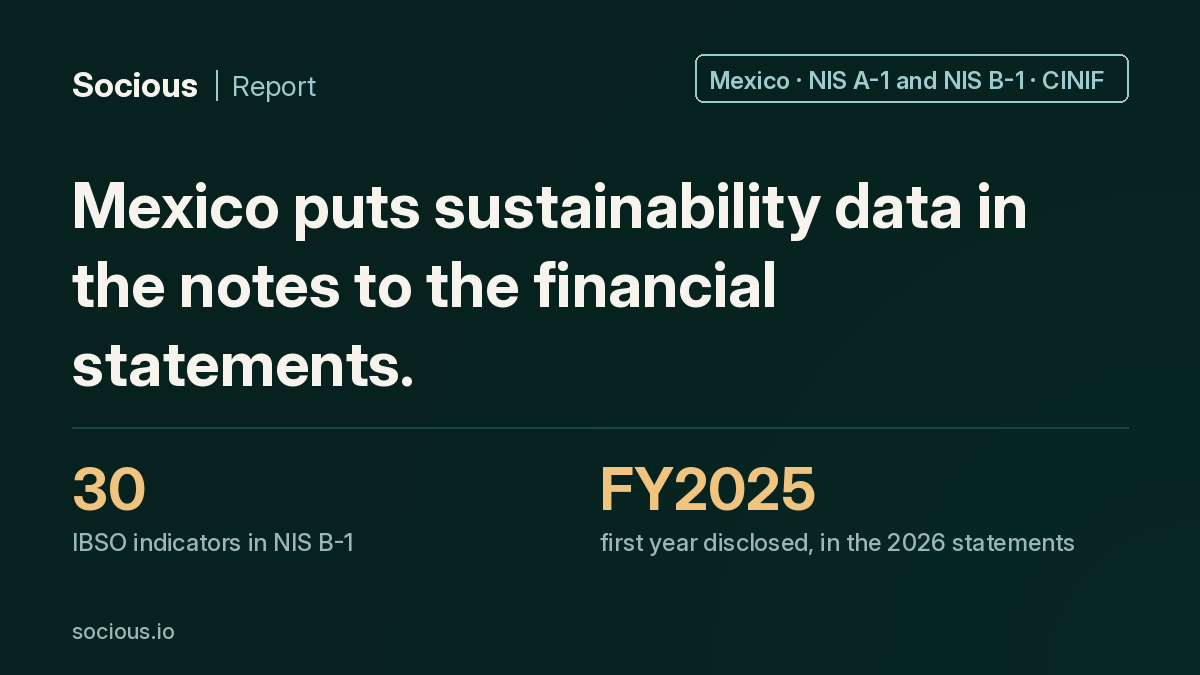
NIS B-1, Basic Sustainability Indicators, is the one that produces disclosure. It carries 30 indicators, known as IBSO, across three pillars: environmental, social and human capital, and governance. Of the 30, 21 are quantitative and nine are qualitative (Jones Day; Greenberg Traurig).
Both took effect on 1 January 2025. Sustainability information is first required in the 2026 financial statements, using fiscal year 2025 data (Greenberg Traurig).
Who has to do it
The test is not listing status, sector or size. It is which accounting framework the entity reports under.
The NIS apply to entities that report their financial statements under Mexican Financial Reporting Standards (Greenberg Traurig). Jones Day puts the obligation in the same terms: entities that issue financial statements under the NIF must prepare and disclose sustainability information in the notes to their main financial statements, covering the same economic entity as the financial statements themselves (Jones Day).
The reporting boundary is the boundary of the financial statements the indicators sit inside. It is not a group sustainability boundary and not a value-chain boundary.
Separately, and on a different track, Mexico’s National Banking and Securities Commission has already required listed issuers to adopt the IFRS Sustainability Disclosure Standards (Jones Day). So a Mexican listed issuer can be inside both: ISSB-based reporting as a securities issuer, and IBSO indicators in the notes as an NIF preparer. They are not the same disclosure and they do not have the same boundary.
If you run a group with a Mexican entity, the question for your local auditor is narrow and answerable this week: are our Mexican statutory accounts prepared under NIF? If they are, NIS B-1 applies to them, whatever the parent files in Brussels or Tokyo.
What NIS B-1 actually asks for
Three features distinguish it from the frameworks a group reporting team already knows.
Every quantitative indicator is reported twice. Each one requires an absolute value and a relative value, the relative figure measured against net revenues (Jones Day). Intensity is not an optional extra disclosure here; it is half of the indicator. A reporting system that stores absolute tonnes and derives intensity for a chart is not storing what this standard asks for.
There is no materiality assessment. At this stage the 30 indicators are simply required (Jones Day). That is the opposite of the double materiality exercise that governs what goes into a CSRD statement, and it removes the usual route to a smaller disclosure. The qualitative indicators, C.4 through C.8 among them, call for descriptive disclosure rather than a number (Jones Day).
The first year is lighter, in two specified ways. Entities may omit Scope 3 emissions, indicator A.3, and Sustainable Investment, indicator A.6, provided they disclose the omission (Jones Day). And comparative prior-period information is not required in the first year of application (Greenberg Traurig).
Both reliefs are written as first-year reliefs. Read plainly, that puts Scope 3 and the comparative column into the following year’s notes, which for a December year end is the set of statements prepared in 2027. We have not seen a CINIF text confirming the second-year presentation in terms, so treat that as the reasonable reading of a first-year relief rather than as a quoted rule, and confirm it locally before you plan around it.
The part that catches group teams
Mexico’s accountancy institute, the IMCP, has said that NIS information does not form part of the audit scope for the financial statements. Where it appears in the notes, the auditor reads it as “other information”, checking for material inconsistency with the audited numbers, but does not opine on it (Jones Day).
So the indicators sit physically inside an audited document, printed next to figures that carry an audit opinion, and are not themselves audited. They are, however, read against those figures for inconsistency. That is a narrow but real exposure, and it is a new shape. Under CSRD the sustainability statement gets its own limited assurance engagement. Under SSBJ the assurance question has its own timeline. In Mexico, for now, the control that bites is not an assurance opinion on the sustainability data. It is the auditor noticing that your sustainability note and your financial statements disagree.
Which they will, if the two are produced by different people from different systems. Revenue is the denominator of every quantitative IBSO indicator. If the net revenue figure used to compute an intensity in the notes is not the net revenue figure in the income statement of the same statements, that is precisely the inconsistency the auditor is reading for.
One dataset, one more destination
For a Japanese or European group, Mexico is rarely a reporting conversation. It is a manufacturing one. And that is exactly the pattern we keep seeing: the entity that has the emissions data is a subsidiary whose finance team has never been part of the group’s sustainability reporting, and the new obligation lands on them rather than on the group.
The group-level problem is familiar. The same underlying measurements now have to come out in a CSRD-shaped statement, an SSBJ or ISSB-shaped disclosure, a customer’s value-chain questionnaire, and now a set of Mexican financial statement notes with its own boundary, its own denominator and its own 30-indicator list. We have written before about what happens when one supplier dataset has to serve four EU filings and about the value-chain data EU customers are asking Japanese manufacturers for. Mexico adds a destination with an unusual property: the output has to reconcile to an audited income statement.
The practical sequence is short.
Confirm the framework. Ask whether each Mexican entity’s statutory accounts are on NIF. That answer, not the group’s reporting calendar, decides whether NIS B-1 applies.
Fix the denominator before the numerators. Every quantitative indicator is a pair, and the relative half runs on net revenues. Agree which net revenue figure, from which statements, before anyone starts collecting environmental data.
Decide the first-year reliefs deliberately. Omitting A.3 and A.6 is permitted and must be disclosed as an omission. That is a decision with a disclosure attached, not a gap to leave quiet, and it is worth taking with one eye on what the following year will require.
Treat it as the same dataset. The fastest way to produce an inconsistency between a sustainability note and an audited statement is to let two teams build the number twice.
Socious Report is built for this shape of problem: assemble the dataset once with its evidence trail, file it into the formats each jurisdiction wants, and put an independent Socious Verify credential on top. If you want to find out where your current emissions data breaks under a controls-based review, the free CSRD readiness check is the quickest route. If the group’s other filing is Japanese, start with the SSBJ readiness check. And if you want the frameworks themselves laid out side by side, what ISSB, IFRS S1 and IFRS S2 actually require is the place to start.