

 Socious Report
 Socious Work
 Socious Verify
Singapore Moved Almost Every Climate Reporting Deadline. It Did Not Move the Date That Decides Who Reports.
Most coverage of Singapore’s climate reporting changes read as relief. Deadlines moved back, smaller listed companies got more time, and the assurance requirement slipped by two years.
That is accurate as far as it goes. What it leaves out is the mechanic that decides which company sits in which tier, because that part did not move, and it was settled on a date that is already behind us.
What ACRA and SGX RegCo changed on 25 August 2025
The Accounting and Corporate Regulatory Authority and Singapore Exchange Regulation announced extended timelines for implementing climate reporting, including external assurance, to support listed companies and large non-listed companies in developing reporting capabilities. The approach for listed companies took immediate effect.
The structure is three tiers, phased on market capitalisation: Straits Times Index constituents, non-STI constituent listed companies with a market capitalisation of S$1 billion and above, and non-STI constituent listed companies below S$1 billion.
Against those tiers, the requirements now run as follows.
Scope 1 and 2 greenhouse gas emissions reporting remains mandatory for all listed companies from FY2025. That did not change.
Other ISSB-based climate-related disclosures, meaning governance, strategy, risk management and the metrics and targets, remain mandatory for STI constituents from FY2025. The S$1 billion and above tier reports them from FY2028. The tier below S$1 billion follows from FY2030.
Scope 3 remains mandatory for STI constituent listed companies from FY2026. For other non-STI constituent listed companies, scope 3 reporting is voluntary until further notice.
External limited assurance for scope 1 and 2 is deferred to FY2029 for all listed companies. The original timeline was FY2027.
Why the timelines moved
The announcement gives its reasons. ACRA and SGX RegCo cite the uncertain global economic landscape, and feedback asking them to take greater account of the varying levels of resources and readiness across reporting companies. It names the Singapore Business Federation, which had argued that smaller listed companies needed more time to be fully ready for ISSB-based disclosures.
ACRA’s Chief Executive described the result as a differentiated implementation approach, one that gives companies who are less ready some relief in the near term while requiring companies who are more ready to progress with their reporting.
A funding line is attached to it. Companies can draw on the Sustainability Reporting Grant run by the Singapore Economic Development Board and Enterprise Singapore to prepare for the other ISSB-based disclosures before mandatory compliance begins, and the announcement notes that the grant’s application deadlines were updated to match the new timetable.
The announcement also frames the capability itself as the point. It says reporting capabilities are required for the longer term to maintain a company’s place in global supply chains, and asks companies to keep aligning their trajectory with Singapore’s net-zero target by 2050.
The eligibility test was taken on 30 June 2025
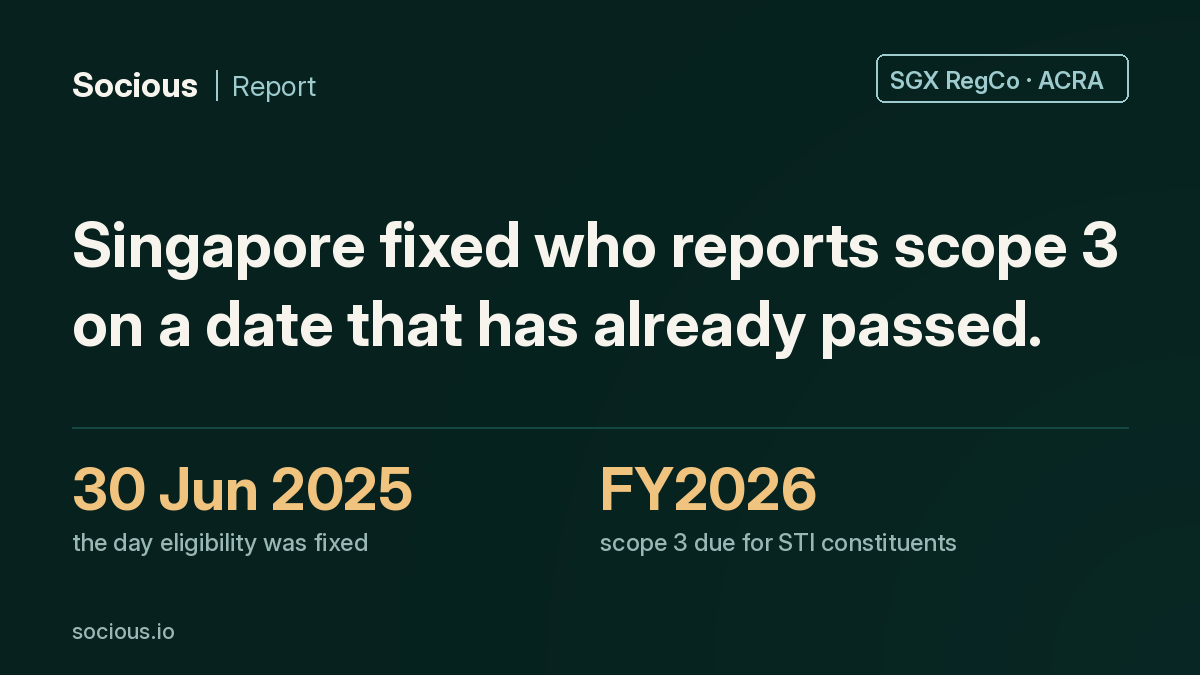
Footnote 2 of the announcement is the operative sentence for anyone working out whether they are caught. The scope 3 requirement applies if a company is an STI constituent on 30 June 2025, even if it ceases to be an STI constituent subsequently.
That is a single-day test, and it was a Monday last year.
The S$1 billion tier works the same way. Footnote 4 says the requirement applies if a company has a market capitalisation of S$1 billion and above as at close of market on 30 June 2025, in which case the report is prepared from FY2028. A company listed after that date with S$1 billion or more at close of market on its listing date is also caught, reporting from the later of FY2028 or its first full financial year after listing. In all cases, the requirement applies even if a company’s market capitalisation falls below S$1 billion subsequently.
So the obligation does not float with the index or with the share price. A company that dropped out of the STI in 2026 still reports scope 3 from FY2026, and one whose market capitalisation has since fallen to S$700 million still reports the other ISSB-based disclosures from FY2028.
For a finance team, that removes a question that would otherwise sit open for two years. Whether the obligation applies is already determined, and it is determinable today from public information. It is not a forecast about where the business will be in 2028.
Scope 1 and 2 stayed put, and the reason was given
Tan Boon Gin, CEO of SGX RegCo, set out why one deadline did not move with the others. The start date for mandatory scope 1 and 2 disclosure was retained because that information is more circumscribed.
The same logic explains the split on scope 3. Paragraph 7 of the announcement says STI constituents keep the FY2026 scope 3 obligation because they have demonstrated a higher degree of readiness and capabilities for such disclosures.
Read together, the two statements describe a regulator sorting requirements by how bounded the data collection is. Scope 1 and 2 come from meters, fuel invoices and purchased electricity inside the company’s own boundary, while scope 3 has to be collected from suppliers, customers and logistics providers who are under no Singapore obligation to hand it over.
Large non-listed companies moved furthest
For large non-listed companies, defined in the announcement as annual revenue of S$1 billion or more and total assets of S$500 million or more, the ISSB-based disclosures including scope 1 and 2 are deferred to FY2030. The original timeline was FY2027.
Scope 3 for this group remains voluntary until further notice. The original position had been voluntary, no earlier than FY2029. External limited assurance for scope 1 and 2 is deferred to FY2032, from FY2029.
A large private company in Singapore therefore has its first mandatory ISSB-based report in FY2030 and its first assured one in FY2032.
Hong Kong went the other way on the same question
The contrast with Hong Kong is worth holding alongside this. HKEX consulted on letting issuers publish a scope 3 work plan where the numbers were not ready, 78% of respondents supported it, and the final Rules removed the option, which we covered in Hong Kong Proposed a Scope 3 Work Plan Instead of Numbers, Then Took It Out.
Hong Kong kept scope 3 mandatory across its whole LargeCap population and took away the work-plan alternative. Singapore kept the obligation for STI constituents only, made it voluntary for everyone else, and fixed membership of that group on a date in the past.
Both are ISSB-based regimes, which is the part that matters for anyone reporting in more than one of them. Our ISSB Adoption by Country: IFRS S1/S2 Tracker (2026) sets out where the rest stand. Timelines differ by jurisdiction, while the dataset underneath them largely does not.
Where to start
If you are an STI constituent as at 30 June 2025, your first mandatory scope 3 report covers FY2026. For a company on a calendar financial year, that year is nearly over, and the question is whether a category-level scope 3 figure can be produced from information you can show was reasonable and supportable at the reporting date.
If you are a non-STI listed company, scope 3 is voluntary until further notice, but the other ISSB-based disclosures arrive in FY2028 or FY2030 depending on which side of S$1 billion you were on at close of market on 30 June 2025. Check which, because it is already decided.
If you are a large non-listed company, FY2030 is further out than it reads. Scope 1 and 2 require a complete energy and fuel dataset across every site, and building that takes longer than drafting the report that uses it.
Socious Report takes one dataset and drafts audit-ready reports against CSRD, SSBJ and ISSB from it, with an independent Socious Verify credential on the result. The collection happens once.
Start with a free readiness check: socious.io/ssbj-check