

 Socious Report
 Socious Work
 Socious Verify
ISSA 5000 Looks at How You Chose What to Report
Most preparation for sustainability assurance assumes the practitioner will arrive and ask about numbers. Where did this figure come from, who checked it, what changed.
They will. But ISSA 5000 also puts a second question in scope, and it is the one most teams have no file for: how did you decide that this was the list of things to report, and that everything else was not?
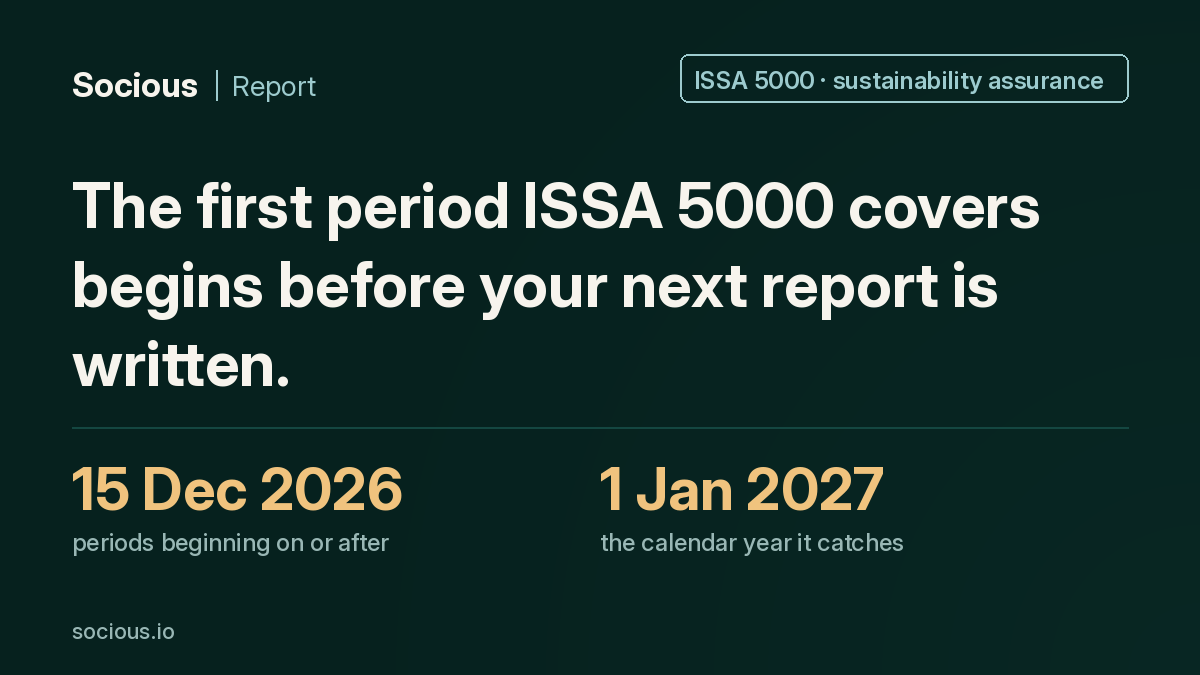
ISSA 5000, General Requirements for Sustainability Assurance Engagements, was issued by the IAASB on 12 November 2024. It is effective for assurance engagements on sustainability information reported for periods beginning on or after 15 December 2026, or as at a specific date on or after that day. Earlier application is permitted (ISSA 5000, paragraph 15, PDF).
For a company whose financial year is the calendar year, the first period it covers is the one starting 1 January 2027.
The standard has an appendix about your process
ISSA 5000 devotes an entire appendix to this: Appendix 2, “The Practitioner’s Consideration of the Entity’s Process to Identify Sustainability Information to be Reported.”
The standard defines the term in paragraph 4. “The entity’s process to identify sustainability information to be reported” means the process you apply to determine which sustainability matters go into the report, and the reporting boundary. If you have run a double materiality assessment for CSRD, or a materiality assessment for IFRS S1, that is the process the appendix is about.
Appendix 2 then traces that process through the whole engagement: acceptance, risk assessment, responding to risks, accumulating misstatements, concluding, and reporting.
Four places it bites
At acceptance. Before taking the engagement, the practitioner has to “consider whether the entity has a process to identify sustainability information to be reported” (paragraph 76(a)). The application material is blunt about why. Without such a process, “it may be difficult to establish whether management or those charged with governance, as appropriate, have a reasonable basis for the sustainability information” (paragraph A187). A missing process is a question at the door, before fieldwork starts.
At risk assessment. Paragraph 117 requires the practitioner to obtain an understanding of your information system and communication, and it lists three things by name. Your process to identify sustainability information to be reported. How information from external sources, including service organisations and other organisations in your value chain, is recorded, processed, corrected and incorporated. And, for estimates and forward-looking information, how you identify the methods, assumptions and data sources, and the need to change them.
Paragraph 118 then requires the practitioner to “evaluate whether the entity’s information system appropriately supports the preparation of the sustainability information in accordance with the applicable criteria.” That is an evaluation, not a description.
When something is missing. Appendix 2 is explicit that misstatements include those arising from material omissions. If the practitioner finds material omissions in the topics or aspects of topics selected for the report, and management corrects them, the practitioner then performs additional procedures on management’s own work to determine whether material misstatements remain (paragraph 157). Uncorrected misstatements are assessed for materiality, individually and in aggregate, by size, nature and the circumstances of their occurrence (paragraph 160).
In the conclusion. Where the sustainability information is materially misstated, the practitioner expresses a qualified or adverse conclusion; where a scope limitation exists and the effect could be material, a qualified conclusion or a disclaimer (paragraph 203). Appendix 2 routes omitted or obscured material sustainability information into exactly that reporting step, so a topic left out without a documented reason can end up affecting the conclusion.
What this means for a CSRD or SSBJ preparer
A double materiality assessment is often run once, by a consultant, in a workshop, and written up as a slide deck with a matrix on it. The matrix lands in the report. The reasoning behind it stays in people’s heads and in a folder nobody can find a year later.
That is the artefact ISSA 5000 brings into scope. Not the matrix, the process that produced it.
Practically, that means a file that records:
- The universe of topics you started from, and where that list came from.
- The evidence behind each materiality decision, including the ones that excluded a topic.
- Who was consulted, including which stakeholders, and when.
- The reporting boundary, and which entities, operations or facilities sit inside and outside it.
- What changed from last year, and why.
The exclusions tend to get the most scrutiny, because a reader who expected a topic and did not find it will ask about it.
The scope of the engagement is not always the whole report
One detail worth settling early with your provider. The scope may cover all of the sustainability information you report, or only part of it, such as a set of key performance indicators (paragraphs 5 and A185). It may also cover the whole reporting boundary, or “only certain jurisdictions, entities, operations or facilities within the reporting boundary” (paragraph A185). That boundary may be fixed by law or regulation, or agreed between the parties.
Those are two different engagements with two different price tags and two different conclusions. Agreeing which one you are buying is part of agreeing the terms, not something to discover in month three.
Both levels, every size
ISSA 5000 applies to all assurance engagements on sustainability information, and to all types of that information, however it is presented (paragraph 8). It covers both limited and reasonable assurance, and unless a requirement says otherwise it applies to both; what differs is the nature, timing and extent of the procedures (paragraph 9). It is intended for assurance engagements on the sustainability information of all entities, regardless of size or complexity, applied in the context of each engagement (paragraph 14).
Practitioners are not required to apply ISAE 3000 (Revised) to an engagement conducted under it (paragraph 11).
The IAASB also describes the standard as profession agnostic, written so that both professional accountant and non-accountant assurance practitioners can use it (IAASB).
Whether ISSA 5000 applies to your engagement in a given country depends on what the regulator and the local standard setter there have adopted. Confirm that with your provider rather than assuming it.
Start with last year’s assessment
Open the materiality assessment behind your most recent report and ask one question of it: if someone asked why a topic is not in here, what document answers them?
If the answer is a slide, there is work to do before the period starts, because the evidence behind an exclusion has to be created at the time the decision is made.
Socious Report builds the report from one dataset, keeps the decisions and their sources attached to the output, and issues an independent Socious Verify credential alongside it (Socious Report).