

 Socious Report
 Socious Work
 Socious Verify
EU Taxonomy Simplification: 64% Fewer Data Points, and a Choice You Have to Disclose
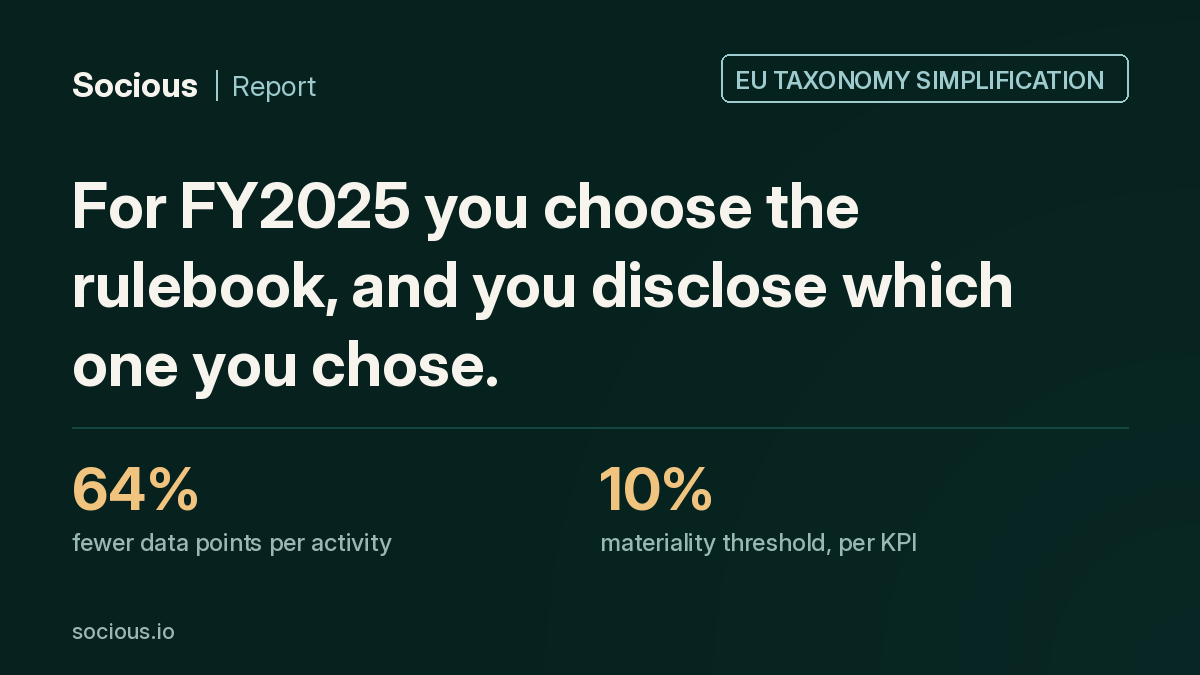
In the sustainability report you file in 2026 for financial year 2025, one sentence in the contextual information has to say which Taxonomy rulebook you applied. The simplified one, or the previous one.
That sentence is new, and the choice behind it has to be made before the data collection starts.
The amending Delegated Act was published in the Official Journal on 8 January 2026 and applies retrospectively from 1 January 2026 (Linklaters). For non-financial undertakings it cuts per-activity data points from 78 to 28, a 64% reduction (Grant Thornton). For financial undertakings the reduction runs up to 89% (Debevoise).
The 64% is the headline. The disclosed choice is the part that has to be decided this year.
The 10% threshold, measured per KPI
Activities that cumulatively make up less than 10% of turnover, CapEx or OpEx no longer require a full Taxonomy compliance assessment. Each KPI is assessed separately, so an activity can be immaterial for turnover and material for CapEx.
Activities you exclude “still need to be reported, but only in summary.”
The threshold removes screening-criteria and DNSH evidence work for a long tail of small activities. The financial allocation work stays, since you still need clean turnover, CapEx and OpEx numbers to show an activity falls under 10%.
OpEx can drop out entirely
Where OpEx is immaterial to the business model, an entity can report total OpEx only, with no eligibility or alignment assessment, provided it explains why OpEx is immaterial.
The immateriality reasoning has to survive the assurance engagement, so it needs a documented basis.
DNSH gets narrower
Appendix C of the DNSH criteria required entities to check activities against large lists of self-classified substances.
The revised act narrows the focus to substances on the European Chemicals Agency candidate list of substances of very high concern for authorisation. For manufacturers the screening work is now scoped to that list.
The financial-undertaking opt-out, and its edges
Financial undertakings get a different set of reliefs. Exposures to entities not required to report under the Taxonomy can be excluded, while exposures to voluntary reporters and known-use-of-proceeds financing can be included. Certain KPIs, including those for the trading book and fee-based services, are delayed until 2028.
There is also an opt-out from the detailed templates until 31 December 2027, covering reports for FY2025 and FY2026, replaced by a statement that no activities qualify as environmentally sustainable. Debevoise notes that the opt-out has to be taken in full, and that it is unavailable to any firm making an alignment claim, which includes green bond issuers.
A bank that expects to issue a use-of-proceeds green bond inside the opt-out window cannot take the opt-out for the year in question.
The choice you have to disclose
For 2026 reports covering a financial year starting or ending in 2025, a company may apply either the original rules or the updated ones. Take the old regime and you apply it in full.
The reporting undertaking should also include a statement in the contextual information of its sustainability report identifying which set of rules it applied for 2025.
The statement sits inside the limited assurance scope. The practitioner checks the figures against the regime it names, including where the application is mixed across KPIs.
What to do before year-end
Which of your activities fall under 10% of turnover, CapEx and OpEx, assessed separately?
Where does your Taxonomy cost actually sit, in screening and DNSH evidence or in financial allocation?
Is OpEx immaterial to your model, and can you write the reason in a form that survives assurance?
And if you are a financial undertaking, does your funding plan include an alignment claim inside the opt-out window?
Socious Report takes one dataset and drafts CSRD, SSBJ and ISSB reports from it, with an independent Socious Verify credential on the result. If you want to see where your current data stands first, our free CSRD readiness check takes a few minutes.